

BULGARIA AND GREECE
26 April–4 May 2027
This fascinating tour combines a visit to the world-renowned Lake Kerkini in Greece with the spectacular mountain scenery of neighbouring Bulgaria. During the course of our stay, we will explore the various habitats around Lake Kerkini in search of Levant Sparrowhawk, Great White and Dalmatian Pelicans, breeding-plumage Black-necked Grebes, stunning White-winged Terns and many more. Weather permitting, we will also take a boat trip out onto the lake to get closer views of the wildlife. The Bulgarian leg of the tour will, of course, take us to the famous Trigrad Gorge for the beautiful Wallcreeper. We will also visit a feeding station for slowly recovering populations of Cinereous, Egyptian and Griffon Vultures, all the while feasting our eyes on a delightful array of colourful European species.
Day 1 We will take a morning flight to Sofia, from where we will drive south of the city for approximately an hour to begin our birding in the mature conifer forests of the pretty Vitosha Mountains. Species we should encounter here include Pallid Swift, the ever-popular Northern Nutcracker, Common Firecrest and Black Redstart. Subsequently, we will make the approximately three-hour drive south to the world-renowned Lake Kerkini in Greece, just across the border between the two countries. En route we will make several stops for refreshment and birding. Three nights in Kerkini.
Days 2–3 Lake Kerkini is an important wetland habitat which sits on a major bird migration route. Surrounded by the Kerkini and Mavrovouni mountain ranges, it is also a particularly picturesque area in which to look for birds. During our stay in Greece, we will visit all the key birdwatching points around the lake. Weather permitting, we will also take a 2–3-hour boat trip out onto the lake to get up close and personal with its many residents. Among the many species we will be looking for here are the famous Great White and Dalmatian Pelicans, Pygmy Cormorant, Purple and Squacco Herons, Great White and Cattle Egrets, Ferruginous Duck, Black-crowned Night-heron, Common Little Bittern, White Stork, Eurasian Spoonbill, Black-necked Grebe in breeding plumage, Glossy Ibis, Black-winged Stilt, Wood, Curlew and Marsh Sandpipers, Common Greenshank, Ruff, Little Stint, Common, Black, Whiskered and White-winged Terns, Little and Mediterranean Gulls, Eurasian Penduline-tit and Great Reed-warbler. In the broad-leaved forests and shrubs, steppes and arid areas in the vicinity of the lake, we should encounter birds such as Levant Sparrowhawk, Eurasian Eagle-owl, Lesser Spotted Eagle, Black Kite, Eurasian Wryneck, Eurasian Golden Oriole, Common Nightingale, Grey-headed and Syrian Woodpeckers, Red-rumped Swallow, Spanish Sparrow, Masked, Woodchat and Red-backed Shrikes, Eastern Black-eared Wheatear, European Turtle-dove, Eastern Olivaceous Warbler, Tree Pipit, Common Cuckoo, Western Rock Nuthatch and Corn and Ortolan Buntings. There is also a chance of finding Rock Partridge in the lower parts of the mountains surrounding the lake, while Red-footed Falcon and Semi-collared Flycatcher are also in the area.
Day 4 Today we will cross the border back into Bulgaria and make our way to the Trigrad area of the Western Rhodope Mountains. The drive takes approximately four hours, but we will break the journey with several birding stops. The Western Rhodopes are characterised by high, rugged mountains interspersed with coniferous forests and meadows. We have excellent opportunities here to see European Bee-eater, European Roller, Rock Sparrow, Greater Short-toed and Calandra Larks, Tawny Pipit, Isabelline Wheatear and Rock Bunting. Mammals may include Balkan Chamois. Two nights in the Trigrad area.
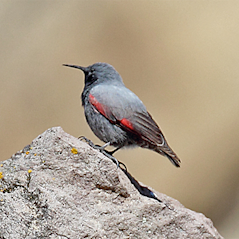
Day 5 In what we hope will be a highlight of the trip for many, today we will explore the spectacular Trigrad Gorge with its dramatic limestone cliffs. The latter make it one of the best places in Europe to find the stunning and highly sought-after Wallcreeper. Other birds likely to be seen in the area include Alpine Swift, Black Woodpecker, Eurasian Crag Martin, Peregrine Falcon, Red Crossbill, Ring Ouzel (ssp. alpestris), Goldcrest, Willow and Crested Tits and European Serin. There is also a very slim chance of finding Hazel Grouse in this area.
Day 6 This morning we will set off on another drive, this time to the Eastern Rhodope Mountains. Again, we will stop for birding and refreshments on the way. By contrast, the Eastern Rhodopes provide a lower, more hilly landscape dotted with grassland, water and deciduous woodland. Mammals we may encounter in this area include European Souslik, Golden Jackal and Wild Cat. We will arrive at our next base of Krumovgrad in the late afternoon and will spend the next three nights here.
Days 7–8 These two days will see us exploring the Krumovgrad and Madzharovo areas, where the habitat includes huge rocks scattered around stony ground, with stunted shrubs and oak forests. There is a feeding station where Cinereous, Egyptian and Griffon Vultures can all be seen well. Many other birds of prey also occur here, and we will be on the lookout for Golden and Booted Eagles together with White-tailed Sea-eagle, Short-toed Snake-eagle, Long-legged Buzzard and European Honey-buzzard. Black Storks should be a fairly common sight as they feed in the rivers. Meanwhile, the forests, bushes and rocks are home to Chukar, Middle Spotted Woodpecker, Common Hoopoe, Blue Rock-thrush, an occasional Rufous-tailed Rock-thrush, Sombre Tit, Barred, Eastern Bonelli’s, Sardinian, Eastern Subalpine and Eastern Orphean Warblers and Cirl and Black-headed Buntings. On one evening we will also try for Eurasian Scops-owl.
Day 9 Today we will make the journey back to Sofia to catch our return flight to the UK. Depending on flight times, we may be able to make a final birding stop or two on the way.
General Information The climate can vary from hot and sunny to cold in the mountains, with some rain possible. The tour pace is moderate with generally easy walks mostly on level ground. There are no significant health requirements.
Group Size Minimum number for tour to go ahead: 6. Maximum group size: 7 with 1 leader.
 Currency converter