


GEORGIA AND ARMENIA
28 April–10 May 2027
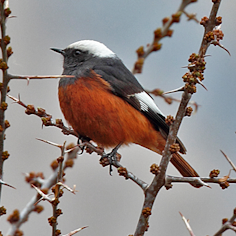
This exciting tour to the farthest reaches of the Western Palearctic offers a unique opportunity to see a number of species at the very edge of their ranges. From spectacular mountain gorges to vast fish ponds in Armenia, we will cover a wide range of habitats in search of such diverse and sought-after species as White-winged (Güldenstädt’s) Redstart, Great Rosefinch, Caspian and Caucasian Snowcocks, Radde’s Accentor, Caucasian Grouse, Wallcreeper, Bearded Vulture and Armenian Gull.
Day 1 Direct lunchtime flight from London Gatwick to Tbilisi, the capital of Georgia, arriving at 20.30, where we will transfer to our comfortable hotel, located just a short distance from the historical part of the city. A meal will be provided at the hotel upon arrival. Overnight in Tbilisi.
Day 2 Today we will head northwards to the Greater Caucasus and the small alpine town of Stepantsminda (1740m) at the foot of the Kazbegi Glacier, our base for the next three nights. We will take our time to complete the journey, making several birding stops en route. The first of these will be at a patch of pine forest near the village of Kojori, where our main objective will be to spot the delightful Krüper’s Nuthatch at the easternmost point of its range. Our next stop will be at the lush Ananuri Forest, where we should be able to pick out Green Warbler along with Semi-collared and Red-breasted Flycatchers. In addition to the birding, we may have time to visit the UNESCO-listed Ananuri Fortified Castle. This fortress is a multifunctional architectural complex built between the 16th and 17th centuries, which was the main seat of the Sidamoni dynasty (Aragvis Eristavi). Our final, brief stop before reaching Stepantsminda will be at the highest point of the Jvari (Cross) Pass. Here, we will look for Caucasian (penicillata subspecies) Horned Lark, Water Pipit and other species in alpine meadows with small creeks and light dustings of snow alongside the former military road constructed by the German army during World War II. On arrival in Stepantsminda, we will first check in to our hotel before driving a short distance to a friend’s house for an authentic homemade lunch. Subsequently, we will explore some of the many scrub patches along the Terek River Valley. Such scrub patches consist predominantly of Sea Buckthorn with some Barberry, and they form an ideal habitat not only for breeding birds, but also for wintering species such as White-winged (Güldenstädt’s) Redstart and Great Rosefinch. These elusive birds breed at an elevation upwards of 3000 metres, but make an altitudinal migration in winter, descending for food and shelter. This is the only Western Palearctic location for these species. As well as these key targets, we will be on the lookout for Mountain Chiffchaff, Red-backed and Lesser Grey Shrikes, Red-throated Pipit, European Honey-buzzard, Montagu’s and Pallid Harriers, Steppe Buzzard, Black Kite and the occasional Steppe Eagle and Red-footed Falcon. In the evening, we will visit the mountain gorge of Kuro, ten minutes east of town. Here, we will scan the rhododendron-covered lower slopes for Caucasian Grouse, while the surrounding shrubs and trees should provide some of our first views of Red-fronted Serin. If time permits, we may visit the upper part of the Kuro Gorge, a couple of minutes’ drive away and a few hundred metres higher. Here, the slopes are rather rugged – typical terrain for Caucasian Snowcock. We should also have our first encounter with Red-billed and Yellow-billed Choughs. Large mammals are also a possibility and we should see a pack of near-threatened East Caucasian (Dagestan) Tur. Three nights in Stepantsminda.
Day 3 Before and after breakfast this morning, we will thoroughly explore a couple of scrub patches as well as a dam. The latter is a known site for a breeding pair of Wallcreepers together with White-throated Dipper. After lunch, we will be picked up by much sturdier CUVs to bump up to the local landmark: Gergeti Trinity Church at an altitude of 2170 metres. From a birding point of view, there is nothing spectacular here, but stunning landscape views are guaranteed. We will finish the day at the beautiful Dariali Gorge, about ten kilometres north of Stepantsminda. Apart from gorgeous views of the surrounding mountain landscapes, here we are likely to have some of many potential views of Golden Eagle and Bearded Vulture on the trip. The gorge also gives us a chance to see Syrian Brown Bear in addition to further chances for East Caucasian Tur.
Day 4 As this will be our last full day in Kazbegi, we will spend it revisiting some of the major sites, depending, of course, on our previous observations. In addition, we will set aside a good amount of time to visit Truso Gorge, 20 minutes south of town. As well as its abandoned shepherds’ village, the gorge contains a nice collection of passerines, including Twite, Common Linnet, Black Redstart, Whinchat and Common Stonechat. From a mammal perspective, Chamois are quite frequently encountered anywhere around these rocky hills, while Gray Wolves are difficult, but possible.
Day 5 Today, as we make our way back to Tbilisi, we aim to make a number of birding stops along the way, including one at the Gudauri Viewpoint. This will give us some lovely landscape views as well as possible sightings of the local Alpine Accentors. Our final, extended stop will be at the Ponichala Forest Park near Tbilisi, which, for good reason, we also call the woodpecker forest! On our wishlists here will be Middle Spotted, Lesser Spotted, Syrian, Great Spotted, Black and Eurasian Green Woodpeckers. Levant Sparrowhawks also breed in the forest, together with Eurasian Scops-owl, the latter of which we have a chance to see at its almost annual roosting branch. Two nights in Tbilisi.
Day 6 Our journey today takes us to the rock-hewn David Gareji Monastery. This fascinating site was created by Christian monks in the 5th century and provides a wonderful juxtaposition of cultural and wildlife attractions. Our drive of approximately ninety minutes will take us through Mediterranean-type arid badlands with multicoloured clay hills covered with shrub and steppe-like vegetation, where a good number of Rosy Starlings, Calandra Larks, Eurasian Skylarks, European Rollers and European Bee-eaters can be found. Raptors including Egyptian Vulture, Eastern Imperial Eagle, Short-toed Snake-eagle, Northern Goshawk and Long-legged Buzzard should be well represented here. The site itself harbours an impressive set of species, such as Pied and other wheatears, Woodchat Shrike, Eurasian Penduline-tit, Common Hoopoe and Eastern Orphean Warbler, so we will keep our eyes peeled and ears tuned for pretty much anything, including migratory birds. This evening, we will take a short walk in the old town and sit down to a sumptuous traditional dinner afterwards to celebrate the successful conclusion of the Georgian part of the tour.
Day 7 After breakfast this morning we will pack the minibus and set off on the hour-long journey to the customs checkpoint at the Armenian border. Once through passport control, we will collect our new bus and make our way to the unique Dilijan Forest, our first birding destination in Armenia. The 24,000 ha Dilijan Forest (which is part of the huge Dilijan National Park), is located in the northeastern part of Armenia and consists of mixed dense forest. Amongst a wide set of passerines and near-passerines, we should see Eurasian Nuthatch, Eurasian Treecreeper, while Booted and Lesser Spotted Eagles may be seen overhead. The second part of today’s programme takes us on a forty-minute drive to the Norashen Reserve, a fabulous birding hotspot located on the southwestern shore of the giant Sevan Lake. The reserve was established in order to protect a unique and well-known breeding site for Armenian Gull on the famous ‘Gull Island’. The massive number of birds in the colony is one of the highest in the entire Caucasus and the world, with over 6000 breeding pairs recorded annually, so if you have never seen this bird before, your dreams will be realised here. In addition to gulls and terns, this area also offers a great selection of waterfowl species, including Black-necked Grebe and Ruddy Shelduck, with both Cetti’s and Marsh Warblers present in the adjacent marshes. Overnight in Dilijan.
Day 8 Our first site this morning will be a fascinating traditional Kurdish village, which hosts a couple of target species for us in the form of Radde’s Accentor and White-winged Snowfinch as well as the feldegg subspecies of Western Yellow Wagtail. Making our way through the gorgeous mountain pass of Vardenyats (also known as the Selim Pass), we will make an extended stop at the caravanserai, situated at an altitude of 2410 metres. This was an ancient rest stop for weary travellers and their animals during Silk Road times, but we will just pause here to enjoy the scenery and have a picnic and coffee among the local Rock Sparrows. After lunch, we will continue towards Noravank Gorge, which covers one of the most picturesque canyons in Armenia and consists of vertical cliffs alternating with steep slopes and covered with red clay. This striking site hosts Eurasian Golden Oriole, Upcher’s Warbler, Chukar, Blue Rock-thrush and Peregrine Falcon. We should also encounter the area’s Bezoar Ibex, which give excellent photographic opportunities as they are not at all shy around humans and can often get very close. Two nights in Yeghegnadzor.
Day 9 Today we will divide our time between two hotspots: the Gndasar (or Yeghegnadzor) Mountains in the morning and Vedi Gorge for the rest of the day. Setting off from the hotel before sunrise, we will use 4x4 vehicles to bump us up to a site in the Gndasar Mountains for the very localised Caspian Snowcock. As soon as we arrive at the gorge and turn off the engine, we should be able to hear the very distinctive calls, which cannot be mistaken for anything else. This should help us pick them out against the craggy slopes. Gndasar covers the southern slopes of the Vardenis mountain range at elevations between 1500 and 2700m, and biotopes here change from mountain steppe to subalpine meadows and jagged rocky outcrops. For anyone who keeps country lists, we have a chance here to see Wallcreeper in Armenia, together with Eurasian Crimson-winged Finch. The surrounding hills often provide nice views of Bezoar Ibex and Syrian Brown Bears, while Caucasian Leopard is very rare and recorded mainly by camera trap. We will spend most of the morning up in this spectacular gorge while in the early afternoon we will start descending to the lower slopes for other highlights, including White-throated Robin. The Vedi Gorge is probably one of the country’s best birding destinations, with its rocky slopes and semi-arid landscape holding a dazzling array of species, such as Grey-necked Bunting, Mongolian Finch, Rock Bunting, Eastern Black-eared and Finsch’s Wheatears and Trumpeter Finch. What’s more, we may also find an interesting collection of reptiles, such as Caucasian Agama, Caucasian Emerald Lizard and Snake-eyed Lizard.
Day 10 En route to Yerevan, our base for the next two nights, we will explore the superb Armash Fish Ponds in the southernmost part of Armenia along the border with Turkey and Nakhchivan (an enclave of Azerbaijan). In good weather, we should have some splendid views of the Biblical, snow-capped Ararat Mountain (5137m). The fish ponds at Armash were created during Soviet times, but nowadays they are a real bird paradise. One of the Caucasus’s best birding sites and the only place that boasts such a large concentration and variety of wetland species, this site will certainly give our checklists a significant boost. Species we should encounter here include Pygmy Cormorant, Common Little Bittern, Glossy Ibis, Purple and Squacco Herons, Black-crowned Night-heron, Ferruginous Duck, Red-crested Pochard, White-headed Duck, an occasional Marbled Teal, Eurasian Spoonbill, White-tailed Lapwing, Collared Pratincole, Whiskered, White-winged, Black and Little Terns, migrant Terek and Curlew Sandpipers, Red-necked Phalarope and Kentish Plover. In addition to the water birds, Ménétries’s, Moustached and Paddyfield Warblers are all common here together with Great Reed-warbler, Olivaceous Warbler, Bearded Reedling and Blue-cheeked Bee-eater. We intend to spend half a day at this fantastic site and will take lunch here before moving on. In the afternoon, we will relocate to the Uranots in the Ararat Valley, the arid steppes in the foothills of the Oorts Mountains. This wonderful hotspot incorporates almost the entire set of unique landscape habitats that occur in the eco-zone between the semi-desert and mountain steppe: rocky outcrops, open juniper woodland, stunted deciduous trees, shrubby thickets and hillsides covered with scant grassy vegetation and sparse growth of Astragalus. The site hosts many interesting species, such as Griffon Vulture, Eastern and Western Rock Nuthatches, Rufous-tailed Scrub-robin and Isabelline and Red-tailed Wheatears. Two nights in Yerevan.
Day 11 Our last full birding day will take us northwest to Mount Aragats, which rises to an altitude of 4090m, making it the country’s highest point. This area provides an excellent opportunity to see woodland, meadow-steppe and subalpine species, as well as an interesting gradation of species across varying altitudinal zones. Ortolan Bunting, Rufous-tailed Rock-thrush and Ring Ouzel can be found within the subalpine zone, while the Caucasian subspecies of Bluethroat is common in the boulder fields of the subalpine zone and near the observatory. Apart from good birding, today we may also stop briefly at one of Armenia’s cultural heritage sites – Amberd Fortress. After lunch, we will explore the meadows in the lower reaches around the mountain in search of Bimaculated Lark. On our last evening together, we will take a short walk in the centre of Yerevan, followed by a celebratory evening meal.
Day 12 Today we will make the five-hour return journey to Tbilisi (via Sevan Lake for some last-minute birding) to catch an evening flight back to London at the end of the tour, arriving London Gatwick just after midnight.
General Information The weather can be highly variable from below freezing with snow in the mountains to warm in the lowlands. The amount of physical effort required is moderate except in the mountains which are more strenuous at altitudes up to 3,000m. Visas are not required for UK citizens in both countries. All areas we will be visiting are entirely safe.
Group Size Minimum number for tour to go ahead: 6; maximum group size: 10 with 1 leader.
 Currency converter