


INDIA
South and Andaman Islands
27 January–14 February 2027
This tour takes us to the tropical island of South Andaman and the Western Ghats on the mainland, two of the finest birding areas on the Indian subcontinent. No other part of the country is richer in endemics, and we will target such sought-after species as Andaman Woodpecker, Andaman Scops-owl, Andaman Crake, Andaman Nightjar, Black-and-orange Flycatcher, White-bellied Minivet, Nilgiri Sholakili, Nilgiri, Palani and Wayanad Laughingthrushes and White-bellied Treepie.
Day 1 Overnight flight from London to Kochi, on the Malabar coast of south-west India.
Days 2–4 We will arrive in Kochi in the morning of Day 2 and will then embark on a two-hour drive inland to Thattekad, our base for the next three nights. Along the way we are likely to become acquainted with a wide variety of typical southern Indian species, such as Black Kite, Black Drongo, Indian Roller, Asian Green Bee-eater, Laughing Dove, Rose-ringed Parakeet, White-throated Kingfisher, Eastern Cattle and Little Egrets and Indian Pond-heron. We will spend the remainder of Day 2 and the following two days at Thattekad, a small yet productive patch of lush lowland forest on the northern bank of the Periyar River. Also known as the Salim Ali Bird Sanctuary in honour of the eminent Indian ornithologist who once described this as ‘the richest bird habitat in peninsular India, comparable only with the eastern Himalayas’, Thattekad is a vital remnant of a once-widespread habitat that is now largely converted to agricultural land and the extensive plantations that characterise Kerala’s lowlands. The low-lying, gently undulating terrain nestling against the foot of the Cardamom Hills is densely covered with tropical deciduous and evergreen forest and dissected by a network of seasonal streams, riverine vegetation, bamboo brakes and patches of scrub and grassland; as a result, its birdlife is rich and varied. Specialities here include a significant number of Western Ghats endemics, including Flame-throated Bulbul, Crimson-backed Sunbird and the near-endemic Grey-fronted Green Pigeon. We will also encounter some more widely distributed regional endemics that occur in both the Western Ghats and into Sri Lanka, including Malabar Trogon, Dark-fronted Babbler and Black-throated Munia. Endemics aside, Thattekad is enormously rich in birdlife, and other species of note include the impressive Great Hornbill, White-bellied Woodpecker, the diminutive Heart-spotted Woodpecker, Speckled Piculet, Black-naped, Black-hooded and Indian Golden Orioles, Oriental Dollarbird, Tickell’s Blue-flycatcher, Blue-throated Flycatcher, Indian Blue Robin, the ground-skulking Puff-throated Babbler, Asian Emerald Dove, Indian Pitta, Red Spurfowl, White-rumped Needletail and Grey-headed Fish-eagle. The sanctuary and surrounding areas are exceptional for night birds and we will place particular emphasis on finding these during our stay. Target species include Sri Lanka Frogmouth and Oriental Scops-owl, and there are good chances here for the scarce and elusive Mottled Wood-owl and the highly-secretive Sri Lanka Bay-owl, as well as Jerdon’s, Jungle and Savanna Nightjars and Great Eared Nightjar. The damp, humid forests are extremely rich in exquisite butterflies, which include endemics such as Malabar Rose, Malabar Banded Swallowtail and Malabar Banded Peacock. Mammals are equally numerous, and we may see Barking Deer, Wild Boar and the nocturnal and secretive Travancore Flying Squirrel. Three nights in a comfortable tented (permanent) wildlife camp on the edge of the sanctuary.
Days 5–6 We will make our way south to our next destination, Periyar National Park, the southernmost site in our itinerary. We will spend the remainder of Day 5 and the whole of Day 6 birding in the hills around the Periyar reservoir, looking for some of the more elusive endemics, in particular the shy Wayanad Laughingthrush. In the rich forests and grasslands of this vast, undulating area we can expect to see a wide selection of Western Ghats and wider regional endemics such as White-bellied Treepie, Malabar Pied Hornbill, Malabar Grey Hornbill, Malabar Starling, Malabar Barbet and Malabar Parakeet, alongside some sought-after winter migrants such as Pied Thrush, and plentiful mammals including Asian Elephant, Gaur and Ussuri Dhole (wild dog). Two nights in a comfortable wildlife lodge on the edge of the reserve.
Day 7 This morning, we will make our way up into the Cardamom Hills of Kerala to Munnar, where we will spend the next three nights. Midway through our four-hour drive we will spend some time at Bodi Ghat, across the state border in Tamil Nadu. The rocky, scrub-covered hills here in the rain shadow of the Ghats are home to the highly-localised Yellow-throated Bulbul (restricted to the southern Deccan plateau) alongside White-cheeked Barbet and Purple-rumped and Loten's Sunbirds. We will arrive in Munnar with time to begin our birding around the town itself. Malabar Whistling-thrush, Rufous Babbler, Blue-capped Rock-thrush and Painted Bush-quail can be found foraging in the understorey at tea estates, while Bonelli’s and Black Eagles, Alpine and Blyth’s Swifts and Brown-backed Needletail are regularly seen over the hillslopes alongside Indian Swiftlet and Hill Swallow, both endemic to the Western Ghats and Sri Lanka. Three nights in a comfortable mountainside resort on the outskirts of the town.
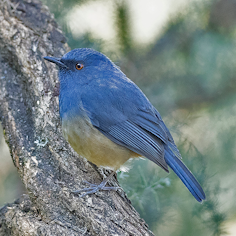
Days 8–9 Located at an elevation of 1600m, Munnar is a former British colonial hill station. The surrounding hills are uniquely picturesque, enveloped by vast expanses of carefully-manicured tea plantation; although these have replaced much of the natural vegetation of the area, the vista they have created is spectacular, and the resultant combination of open grassland and vegetated gullies amidst the tea and patches of woodland shading cardamom crops has allowed a variety of species to flourish here. Much of our time in Munnar will be spent on upland plateaus and in patches of protected native shola forest in the surrounding hills. Among these shola–grassland mosaics, we will be looking in particular for White-bellied Sholakili, Palani (formerly Kerala) Laughingthrush, Nilgiri Flycatcher and Nilgiri Pipit, as well as one of the most elusive of the region’s endemics, Broad-tailed Grassbird, which may take special effort to find. We are also likely to encounter a good selection of mammals, which, alongside Nilgiri Tahr, may include the endemic Nilgiri Langur and the Nilgiri race of Dusky Palm Squirrel; endemic butterflies in the area include Red-disc Bushbrown and Palni Four-ring, confined solely to the shola–grassland ecosystem.
Day 10 We will leave Munnar early this morning to embark on a seven-hour drive north to the erstwhile colonial hill station of Ooty at a height of 2268m in the rolling Nilgiri Hills, or Blue Mountains. The journey will take us from the Cardamom Hills of Kerala into the Nilgiri Hills of the neighbouring state of Tamil Nadu. Although we have a long drive ahead, we will make some stops along the way. We will spend an hour or two in the morning at Chinnar Wildlife Sanctuary. In contrast to most protected areas within the Western Ghats, Chinnar lies in the rain shadow of the Ghats. The vegetation here is a rich combination of coastal Malabar and peninsular Deccan elements, dominated by thorn scrub and dry deciduous forest, making it hugely ecologically important as a pocket of this distinct habitat type. The rugged terrain within the sanctuary is dissected by two perennial rivers whose riparian forests support a healthy population of Grizzled Giant Squirrel. Spot-bellied and Indian Eagle-owls and Brown Fish-owl can be found at roost here, while the striking Black Baza, White-naped and Rufous Woodpeckers, Blue-bearded Bee-eater, Sirkeer Malkoha, White-rumped Shama and Rain Quail are among other interesting inhabitants. We will arrive in Ooty in the evening and will spend two nights in a comfortable mountainside resort on the outskirts of the town.
Day 11 Ooty, with its pleasant summer climate, was originally developed as a retreat to escape the oppressive heat of the plains. The town still serves this purpose, and is one of India’s primary tourist destinations in the summer months. During the winter, when temperatures are cooler, the town is deserted, making Ooty the perfect place to look for the resident endemics of these hills. Although Ooty’s native forests have been largely replaced by tea, eucalyptus, conifers and vast arable farms, some small fragments of montane shola remain. A shola is a patch of high-altitude, stunted temperate forest that exists in a sheltered valley or fold created by rugged terrain; each patch is isolated from the next by extensive rolling grassland. This environment, unique to the southern portion of the Western Ghats, is home to some of the endemic species with the most restricted ranges – those with an affinity only to the evergreen forests of north-east India or south-east Asia, and in many cases nowhere else in the world. Ooty’s sholas provide refuge to the more altitude-dependent endemics of the Western Ghats, in particular the striking Black-and-orange Flycatcher, Nilgiri Sholakili, the nomadic Nilgiri Woodpigeon and perhaps the most difficult of all, Nilgiri Thrush. We will spend the day at Ooty exploring these remnant sholas in addition to paying a visit to the nearby Doddabetta (literally ‘big mountain’), the Ghats’ second highest peak at 2638m. This is an excellent place to find Nilgiri Laughingthrush, which is often confiding here yet difficult to find elsewhere. Additional species we may see in the area include Indian Scimitar-babbler, Indian Blackbird, Southern Hill Myna, Mountain Imperial-pigeon, White-bellied Blue-flycatcher, Rusty-tailed Flycatcher, Grey-headed Canary-flycatcher, Large-billed Leaf-warbler, Western Crowned and Greenish Warblers, Yellow-browed and Square-tailed Bulbuls, Velvet-fronted Nuthatch, Common Rosefinch, Forest Wagtail and Grey Junglefowl, while Ooty is also perhaps the only reliable place in southern India to find wintering Kashmir Flycatcher, a species otherwise found only in Sri Lanka during the winter months.
Day 12 If necessary, we will spend the early hours of Day 12 around Ooty, otherwise we will make our way down through the foothills to our next destination, Mudumalai National Park. The drive will take us along roads flanked with bird-rich forests, and there are likely to be numerous distractions along the way. Mudumalai was southern India’s first wildlife sanctuary and today forms an integral part of the larger Nilgiri Biosphere Reserve, aimed at preserving some of the finest forest remaining in this region. The reserve encompasses the foothills of the Nilgiri Hills, extending from the moist tropical forest of the western slopes of the Ghats to the tropical dry forest of the eastern slopes and into the dry deciduous forests and tropical thorn scrub of the Deccan plateau inland. Forested hills, valleys and scrub-filled ravines are interspersed with streams and marsh, and the varied habitats make this productive birding country. We will spend the afternoon around Mudumalai, where we hope to find the endemic Malabar Lark, Nilgiri Flowerpecker, Malabar Woodshrike and Grey-headed Bulbul as well as the highly-localised White-bellied Minivet, for which Mudumalai is a known stronghold. Mudumalai is home to a host of additional species, many of which we are unlikely to see elsewhere, including Tawny-bellied, Yellow-billed and Yellow-eyed Babblers, White-browed Bulbul, Indian Nuthatch, Blue-faced Malkoha, Bay-backed Shrike, Bar-winged Flycatcher-shrike, Black-headed Cuckooshrike, numerous woodpeckers including Streak-throated, Yellow-crowned and Brown-capped Pygmy, Lesser Yellownape, Jerdon’s Bushlark, Painted Spurfowl and Grey Francolin. In addition, Mudumalai hosts one of the largest populations of Asian Elephant in India, and we are likely to encounter these among a good selection of other mammals including Southern Plains Grey Langur, Bonnet Macaque, Sambar, Spotted Deer, Indian Muntjac, Wild Boar and Malabar Giant Squirrel. Overnight in a comfortable wildlife lodge on the edge of the sanctuary.
Day 13 We will spend the morning at Mudumalai before departing on the five-hour drive to Bangalore, where we will spend the night. Depending on the species we have seen and any specialities we have so far missed, there may be opportunities to stop along the way. In particular, we will have the chance to look again for Yellow-throated Bulbul. Overnight in a comfortable hotel in Bangalore.
Day 14 Today will be a travel day, taking us from Bangalore to the Andaman Islands. We will make an early start this morning to catch our flight across the Bay of Bengal to the city of Port Blair on the island of South Andaman. On arrival in Port Blair we will make the short transfer to our comfortable coastal hotel, our base for the next four nights. Port Blair is making a rapid transition from a forgotten outpost to a busy commercial centre, but despite the inevitable accompanying deforestation, some good birds can be found here, in particular along the extensive coastline and adjacent creeks and marshes. We are likely to arrive with time this afternoon to begin exploring a variety of habitats around the town, where we can expect a good introduction to the islands’ more widespread species, such as Clamorous Reed, Dusky and Thick-billed Warblers, Long-tailed and Red-breasted Parakeets, White-bellied Sea-eagle, Stork-billed Kingfisher, Watercock, Pacific Reef-egret and, at low tide, a good selection of waders which may include Wood and Curlew Sandpipers, with a chance of the scarcer Great Knot. Four nights in a comfortable coastal hotel in Port Blair.
Days 15–17 Three further days will be spent making excursions from our base at Port Blair to a series of productive birding sites around the island. At the southernmost tip of South Andaman, Chiriyatapu (literally ‘bird point’) is one of these. A small yet productive patch of coastal rainforest, Chiriyatapu was severely degraded by the 2004 tsunami but is recovering well and is an excellent location for endemics, in particular Andaman Serpent-eagle, Andaman Woodpecker, White-headed Starling and the near-endemic Andaman Coucal. We will also spend time in search of Andaman Crake, foraging among the leaf litter in damp gullies; although not uncommon at Chiriyatapu, this is a highly-elusive species more easily heard than seen. At the point itself, the forest gives way to sandy beaches where Ruddy Turnstone, Lesser and Greater Sand Plovers and, rarely, the impressive Beach Thick-knee can be found. North of Port Blair, Mount Harriet National Park is a small area of dense, tropical evergreen and semi-evergreen rainforest; as most reserves in the Andaman Islands were created to protect marine ecosystems, this is one of the few terrestrial environments to be given true protected status. A narrow road winds its way from the base of the hill to its peak, making this an easy place to bird and allowing easy access to dense forest that provides ideal habitat for a variety of species including most, if not all, of the endemics occurring on South Andaman. Many of these, including Andaman Shama, Andaman Bulbul and, most commonly, the near-endemic Andaman Drongo, associate with species such as Greater Racket-tailed Drongo, Asian Brown Flycatcher, Black-naped Monarch, Asian Fairy-bluebird, Vernal Hanging-parrot, Large Cuckooshrike and Asian Glossy Starling in fast-moving, mixed-species feeding flocks. At lower elevations, Andaman Woodpecker, Andaman Treepie and Andaman Cuckoo-dove can be found in open scrub forest, while dense forest towards the peak is home to White-headed Starling, the near-endemic Andaman Green Pigeon and the scarce and elusive Andaman Woodpigeon. The summit itself, at 383m, is the highest point on South Andaman and one of the highest in the entire archipelago. This is an exceptional watchpoint for raptors and hirundines, in particular Crested Serpent-eagle, Changeable Hawk-eagle, Edible-nest Swiftlet and White-breasted Woodswallow. Alongside the endemics, the forests host a wide diversity of species including Yellow-browed Warbler, Olive-backed Sunbird, Orange-headed Thrush, Green Imperial-pigeon, Alexandrine Parakeet, Blue-tailed Bee-eater, Small and Scarlet Minivets, Brown Shrike and the andamanensis race of Freckle-breasted Woodpecker. Andaman and Hume’s Boobooks, Andaman Scops-owl and Andaman Nightjar, all endemic to these islands, occur within the sanctuary and we will spend at least one late evening here in an attempt to locate these species as they begin to call at dusk. Throughout the Andamans, an extensive network of mangrove-lined tidal creeks and marshes, interspersed with flooded fields and plantations, hosts an incredible range of waterbirds. The archipelago sits along the East Asian–Australasian flyway, which supports an estimated five million migratory shorebirds, making areas such as these vital for wider populations of many species. During our stay on the island we can expect to see species such as Long-toed and Red-necked Stints, Terek and Broad-billed Sandpipers, Bar-tailed Godwit, Whimbrel, Common and Pin-tailed Snipes, Great and Intermediate Egrets, Striated Heron, Cinnamon and Yellow Bitterns, Slaty-breasted Rail, Ruddy-breasted and Baillon’s Crakes, Ruddy, Collared and Black-capped Kingfishers, Mangrove Whistler and good numbers of Andaman Teal among Lesser Whistling-ducks and Cotton Pygmy-geese.
Day 18 We will have time for some final birding this morning before leaving Port Blair on an afternoon flight back to Bangalore. We will arrive in Bangalore by evening, with a chance for dinner and rest in a comfortable city hotel before returning to the airport at around midnight to catch our international flight back to London very early tomorrow morning.
Day 19 Early morning flight back to London at the end of the tour.
General Information India is quite hot at this time of year but rain is unlikely. The pace is easy but the heat can be tiring at times. On most days we will split the birding into two sessions, with a break in the middle of the day so we can take time off to relax. There are a number of health requirements and you must consult your GP in this respect. Insects are not a major problem but you must take precautions to avoid other health risks. Accommodation is in medium-standard hotels, all with private facilities. Visas are required.
Group size Minimum number for tour to go ahead: 4; maximum group size: 12 with 2 leaders.
Pre-tour extension: Tansa/Forest Owlet
25–27 January 2026
Day 1 Overnight flight from London to the city of Mumbai on the west coast of peninsular India.
Day 2 Arrival in Mumbai, where we will spend the night. Depending on our arrival time, we may have time for some initial birding around the city. Overnight in a comfortable hotel in Mumbai.
Day 3 An early start this morning will see us driving east out of the city to Tansa Wildlife Sanctuary. We will spend the day exploring forests of Teak and Sal, with our main target here being the localised endemic Forest Owlet. Tansa will also provide a good introduction to the birds of western India, and we are also likely to find several species restricted to the Western Ghats or peninsular India, perhaps including Malabar Trogon, Brown-cheeked Fulvetta and Jerdon’s Leafbird. In particular, we hope to see Vigors’s Sunbird, an endemic species with a range that does not extend south into areas covered by the main tour. Other birds we may see in these deciduous forests include White-eyed Buzzard, Tickell's Thrush, Black-hooded Oriole, Ultramarine and Taiga Flycatchers, Indian Grey Hornbill, Crested Treeswift and both Spotted and Jungle Owlets, some of which may not be so readily available further south along the Western Ghats. We will return to Mumbai in the late evening.
Day 4 (Day 2 of the Main Tour) Today we will catch an early flight south along the coast to Kochi, where we will join the main tour later this morning.
 Currency converter